I’ve been testing the GPTinf humanizer on different AI-written texts and I’m not sure if it actually makes the content safer or just harder to detect. I need help understanding how accurate and reliable it really is, and whether it’s worth using for blogs or client work without risking SEO penalties or trust issues. Anyone with real experience or detailed insights, please share your thoughts.
GPTinf Humanizer review from someone who spent way too long testing these things
I went down a rabbit hole with AI “humanizer” tools a while back. GPTinf was one of the first ones I tried because their homepage throws a big “99% Success rate” number in your face. That claim did not survive contact with reality.
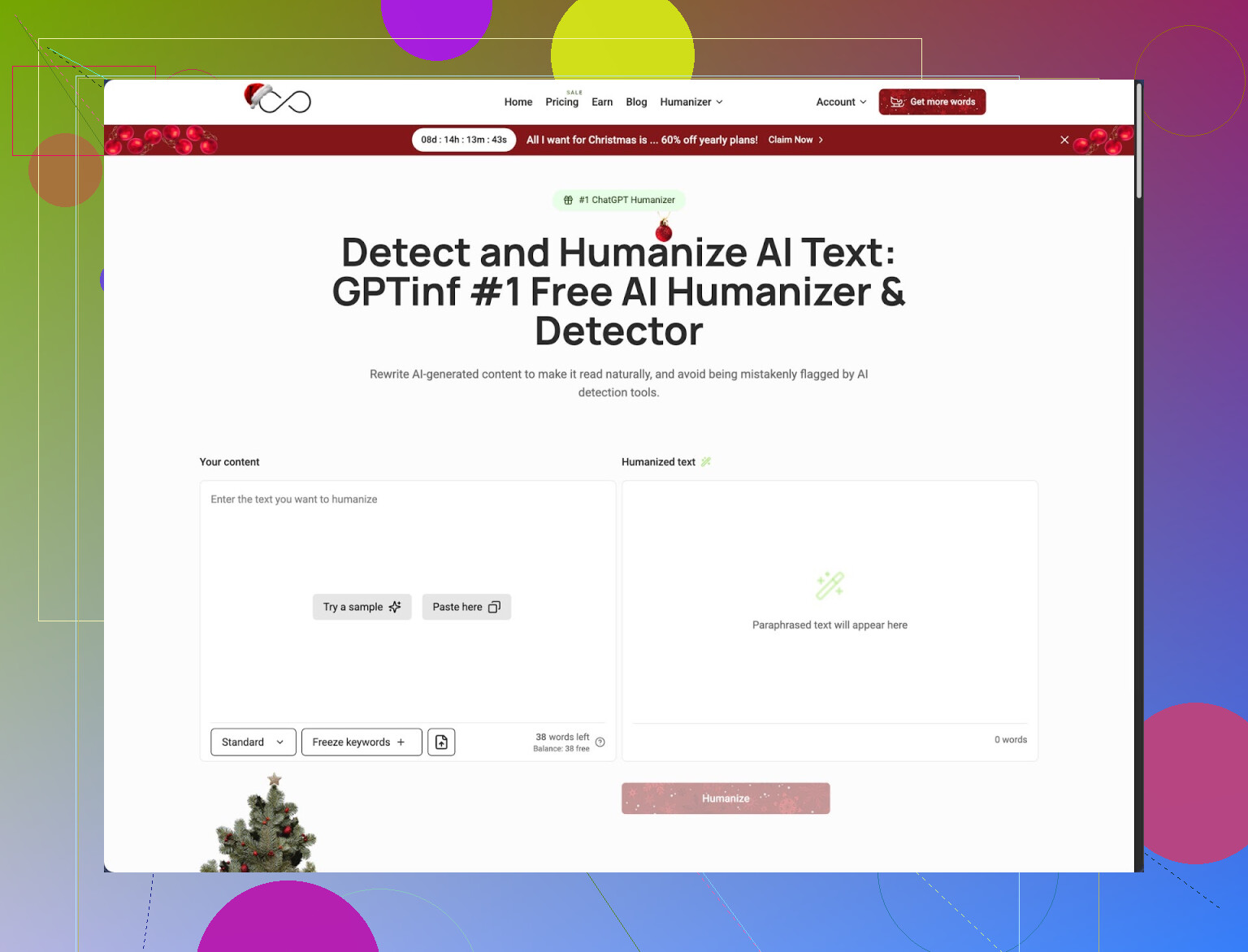
If you want the original reference, this is where I started:
How the detection tests went
I took multiple chunks of obvious AI text, ran them through GPTinf in different modes, then sent the results straight into GPTZero and ZeroGPT.
Every single output got flagged as 100% AI.
Not “partially AI”. Not “likely AI”. Straight 100%.
This happens no matter which mode I picked. I rotated:
- Short vs long texts
- Different topics
- Different writing levels
Same verdict every time. Detection score: 0 out of 10 from me.
So that 99% success claim on the homepage did not match my experience at all.
Writing quality and quirks
Now, the text itself is not terrible.
If I ignore the detection side and read it as a writing tool, I would rate the quality around 7 out of 10:
- Sentences are fairly clean
- Grammar is mostly fine
- It keeps a consistent tone
One thing I noticed, and this will matter to some people: GPTinf strips out em dashes from its output. A lot of AI tools overuse them, and some detectors flag that pattern. GPTinf actually removes them.
That told me something interesting. Whoever built it tried to tweak surface patterns, like punctuation, but they did not break the deeper “AI rhythm” of the text. Detectors still saw the same usual patterns underneath.
Comparison with Clever AI Humanizer
While I was testing GPTinf, I kept going back to Clever AI Humanizer as a comparison point.
Clever’s outputs felt more like someone who rewrote the text with some thought:
- Sentence structure varied more
- Word choice drifted further from standard LLM style
- Detectors scored it better in my tests
- And it stayed free, which matters once you start processing lots of content
Every time GPTinf failed detection, I took the same original text, ran it through Clever, and got noticeably better scores, without paying.
Limits and pricing
This part annoyed me more than I expected.
GPTinf free tier:
- Without an account, you get about 120 words per run
- With an account, it goes up to 240 words
If you want to do serious testing, those caps get in the way fast. I ended up creating extra Gmail accounts to push more samples through, which felt like busywork.
Paid plans looked like this when I checked:
- Lite plan: around $3.99 per month on annual billing, 5,000 words
- Unlimited: around $23.99 per month
On paper, those prices are not terrible. The issue is not the price, it is that the core promise did not hold up against detection tools in my tests. Paying for something that fails its main job did not make sense for me.
Privacy and data ownership
I read the privacy policy because I was going to paste client text into it. A few red flags for my use case:
- The policy gives them broad rights over submitted content
- It does not clearly explain how long your text stays on their servers after processing
- It also does not spell out what happens if they reuse or analyze your text internally
GPTinf is run by a single proprietor in Ukraine. That part is not good or bad on its own, but it does matter if your work is sensitive or regulated, or if your company has rules about data jurisdiction.
If you work with client docs, legal text, medical content, or anything like that, you want to know where that data sits and how long it sticks around. I did not get clean answers from their policy.
What it felt like to use in practice
After a few days hopping between tools, here is how it shook out for me:
-
GPTinf:
- Produces readable text
- Fails detection in every test I ran
- Word limits on free tier are tight
- Privacy details feel vague
-
Clever AI Humanizer:
- Gave me more natural rewrites
- Performed better in GPTZero and ZeroGPT
- Stayed free when I used it
- Did not force me into signups as quickly
When I had to process real content for work, I stopped opening GPTinf and kept using Clever. GPTinf looked promising on the homepage, but in actual use, it did not deliver what I needed most, which was reduced AI detection risk plus sane handling of my text.
1 Like
Short answer from my side, after playing with GPTinf and other tools too:
-
Detection safety
For me, GPTinf outputs still scored as AI on GPTZero and ZeroGPT in most runs. Not always 100 percent like @mikeappsreviewer saw, but high enough that I would not trust it for anything high stakes. I saw stuff like 80 to 100 percent AI probability on academic style text and blog style text. -
“Safer” vs “harder to detect”
You asked if it makes content safer or only harder to detect. GPTinf mainly tries to make it harder to detect. It tweaks wording, punctuation, and sentence flow. It does not fix factual errors, weak arguments, or legal risks in the text. So it does not make your content safer in the sense of compliance or truth. It only aims at detectors. -
Style fingerprint
I noticed a few patterns.
• It prefers short, neat sentences.
• It avoids strong personal voice.
• Vocabulary stays close to default LLM style.
That mix still looks “AI shaped” to detectors. Humans will find it readable, but it feels neutral and templated if you compare it to a real person’s messy draft.
- Reliability across text types
My rough pattern from tests:
• Casual blog copy, marketing pages: sometimes lower scores, but still flagged as “likely AI” often.
• Academic essays, reports: almost always flagged as AI.
• Super short answers: detectors are unreliable in general, so scores jumped around, but that is not a win for GPTinf, more a limit of detectors.
So I would rate “accuracy” of their 99 percent anti detection claim as low. It works better on light, informal content. It fails more on structured, formal writing.
-
Practical risk view
If you need:
• School or uni work: I would not rely on GPTinf alone. Mix in your own edits, change structure, add your own examples, references, and mistakes.
• Client or company content: focus more on quality, unique data, and original structure. Detectors are noisy. Policy violations hurt more than an AI flag. -
Privacy and workflow
The data handling policy looks vague to me too. For anything sensitive, I would avoid pasting raw client or internal docs into it. Use local editing or at least strip identifiers before you send text anywhere. -
Alternatives
If your main goal is lower AI detection scores, Clever AI Humanizer did better in my tests and matches what @mikeappsreviewer saw. It tends to change sentence structure more and pushes vocabulary further from default LLM phrasing. You still need to review and personalize the output, but as a tool in the workflow, Clever AI Humanizer looks stronger for that specific SEO friendly “undetectable AI content” use case.
My blunt take. GPTinf is fine as a light rewriting tool. It is not reliable if you need strong protection against AI detectors or want safer content in the legal, ethical, or factual sense.
Short version: GPTinf mostly makes AI text different, not meaningfully safer, and only somewhat harder to detect.
I agree with @mikeappsreviewer and @cazadordeestrellas on the big picture, but I would push back on one thing. I do not think GPTinf is totally useless for detection, just very inconsistent and context dependent.
Here is how I would break it down:
- What it actually does
GPTinf is basically a stylistic filter. It:
- Swaps phrasing and punctuation
- Simplifies or slightly reshapes sentences
- Tries to smooth out some “AI tells” like repeated structures
What it does not reliably do:
- Change argument structure in a deep way
- Add personal experience or domain nuance
- Fix weak logic or shallow reasoning
So if your original text is classic LLM “informative but generic,” GPTinf usually preserves that skeleton.
- “Safer” vs “harder to detect”
You asked if it makes content safer. In terms of:
- Plagiarism risk: marginal improvement, since it changes wording a bit
- Factual safety: no, it does not verify anything
- Policy or legal safety: no, it will happily polish problematic content
- Academic integrity: absolutely not, it just hides the source a bit
So I would say it only tries to make it harder to detect, and even there it is hit or miss.
- Reliability and accuracy of their claims
Their 99 percent claim feels like classic landing page marketing. Across what I have seen from people actually testing:
- On formal essays and reports it gets flagged a lot
- On casual web copy it sometimes slides by, but not reliably
- On short chunks detectors are noisy anyway, so the “success” is not really GPTinf, just randomness
In other words, GPTinf is not “accurate” in the sense of giving you predictable low detection scores. You cannot count on it for anything where getting flagged has real consequences.
- Where I slightly disagree with the others
Both @mikeappsreviewer and @cazadordeestrellas are pretty harsh on detection performance, which is deserved in many cases, but in some niche scenarios GPTinf is not completely hopeless.
- If you already heavily edit your AI text by hand
- Then run it through GPTinf as an extra noise layer
- Then tweak it again yourself
In that kind of workflow it can sometimes nudge you under certain detector thresholds. The catch is that by the time you do all that, you have done most of the work, not GPTinf. It becomes just another rewriting step, not a magic cloak.
- Human vs AI “feel”
Detectors aside, the output still reads a bit “AI shaped”:
- Neat, tidy, mid length sentences
- Safe, neutral tone
- Generic word choices
If your goal is content that actually feels like a specific person wrote it quirks, opinions, throwaway details you will need to inject that yourself. GPTinf will not give you that authentic messiness.
- Alternatives and workflow suggestion
If you are playing this game specifically for “undetectable AI content,” a tool like Clever AI Humanizer tends to:
- Push structure harder
- Drift further from the original phrasing
Which makes it more useful as part of a detection focused workflow, as long as you still review and customize the final text yourself.
What I would actually do in practice:
- Use any model you like to draft
- Manually change structure, examples, and ordering of points
- If you still care about detectors, optionally pass it once through something like Clever AI Humanizer
- Add your own voice, minor mistakes, local references, etc
If you are looking at GPTinf as a one click safety button, it is not that. It is a mild rewriter wrapped in heavy marketing.
Short take: GPTinf is a weak “cloak,” not a safety net.
I think @cazadordeestrellas, @viajantedoceu and @mikeappsreviewer are basically right on the detection side: GPTinf does not live up to its 99 percent anti detection marketing. Where I slightly disagree is on its usefulness: I see it as a passable low tier rewriter for generic content, not completely useless, just very misbranded.
A few specific angles they did not lean on as much:
- Risk profile, not just detector scores
Detectors are only one risk. In practice, the bigger problems are:
- Reused structure that looks like a template to teachers or editors
- Shallow, pattern based reasoning that real experts spot instantly
- Tone that does not match your previous work
GPTinf barely touches those. It can actually increase risk if people believe the marketing and stop doing their own heavy editing.
-
Consistency with your own voice
One thing I noticed: GPTinf tends to normalize everything toward a bland “middle” voice. If you already have a distinctive writing style, running your text through it can make future work look suspiciously different. That mismatch is exactly what professors and clients pick up on. In that sense, it can hurt you even if detectors say nothing. -
Where GPTinf can be “okay”
If you treat it as:
- A fast tool to smooth grammar on low importance blog posts
- A way to quickly remove some repetitive phrasing before you rewrite more deeply
then it is acceptable. Just do not confuse that with genuine humanization or safety.
- Clever AI Humanizer in that picture
Since you mentioned tools, here is how I see Clever AI Humanizer compared to GPTinf, focusing on pros and cons and not just detector screenshots:
Pros of Clever AI Humanizer
- Tends to alter sentence structure more aggressively, which breaks obvious AI patterns
- Word choice is pushed further from typical model phrasing, so text feels less “template” like
- Plays nicer with informal, web first content where a looser style is an advantage
- Currently usable as a free option in many cases, which is practical for lots of testing
Cons of Clever AI Humanizer
- Can overshoot and distort nuance if the source text is technical or subtle
- Output sometimes feels like a different writer entirely, so you must re inject your own voice
- Not a factual or compliance layer, same issue as GPTinf
- If you rely on it too heavily, you still get that slightly generic “internet content” flavor
In other words, I would treat Clever AI Humanizer as a stronger component in a workflow, not a magic one click fix. It gives you a better starting point than GPTinf if your goal is lower AI style signals, but it still needs human cleanup.
- How I would actually use any of these
- Draft with your model of choice
- Restructure ideas yourself: move sections, merge points, add your own examples
- Optionally send a near final draft through Clever AI Humanizer just once
- Then manually restore your tone, tiny quirks, and domain depth
GPTinf can sit in step two as a light rewriter if you already have a human pass planned, but trusting it alone is asking to get caught by either detectors or simple “this doesn’t sound like you” suspicion.