I’m considering using Phrasly’s AI humanizer for rewriting content, but I’m not sure if it’s safe, natural-sounding, or good for SEO. Has anyone tested it for longer blog posts or web copy, and did it pass AI detectors and avoid plagiarism issues? I’d really appreciate detailed feedback before I commit to using it on my main site.
Phrasly AI Humanizer review, from someone who hit its limits fast
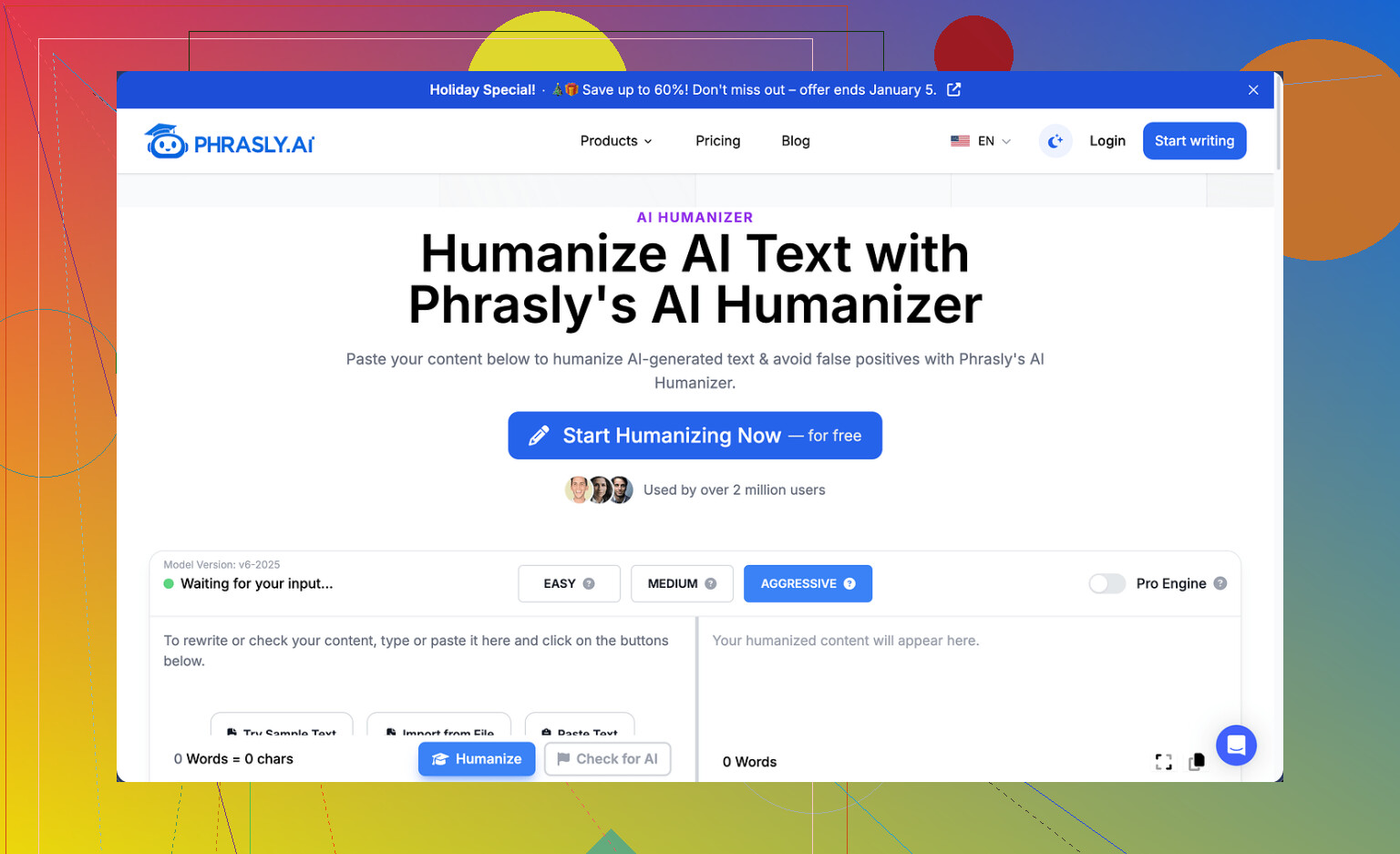
I went into Phrasly here
expecting to at least get a few solid test runs.
That did not happen.
The free tier gives you roughly 300 words total. Not per day, not per week. Total. Once you hit that cap, you are done. On top of it, they lock it to your IP, so you cannot spin up a couple of throwaway accounts to test more samples.
Because of that, I only managed to run one proper test instead of the usual three I run for tools like this.
Here is what I did and what broke
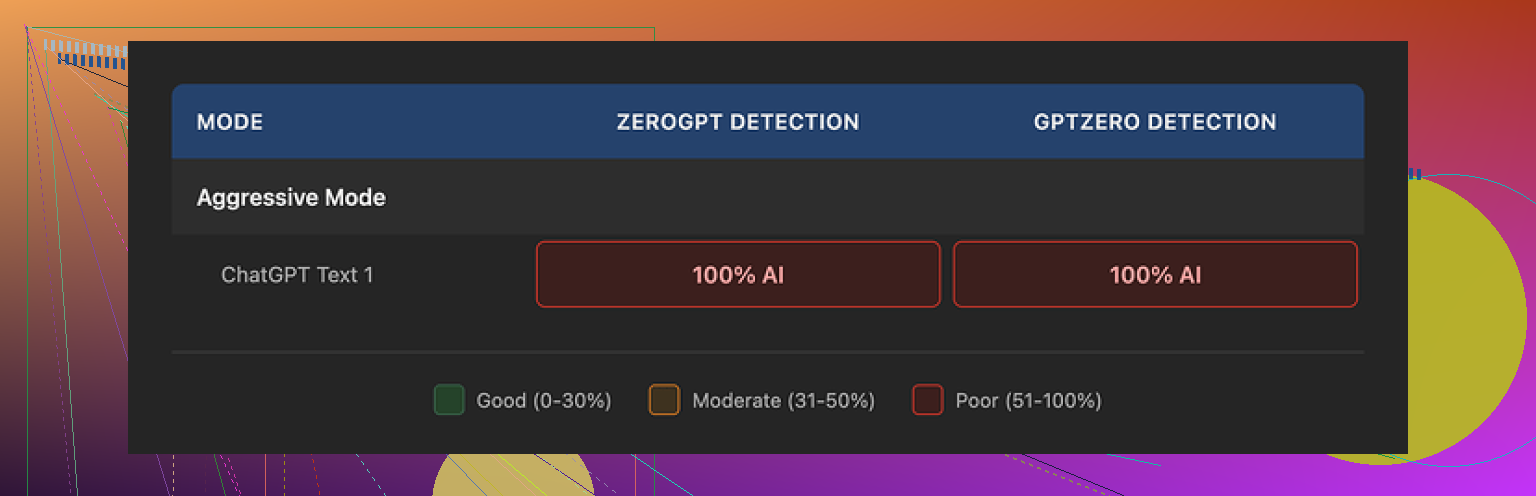
I took a 200 word chunk of standard AI-looking text, academic style, and ran it through Phrasly with their own recommended settings:
Strength: Aggressive
Goal: maximum detector bypass
Result:
GPTZero: 100 percent AI
ZeroGPT: 100 percent AI
The Aggressive setting made no measurable difference. If there is smarter behavior in there, it did not show on that run.
How the output looked to a human
On the surface, the output was not awful.
• Sentences were clean and grammatical.
• Tone stayed academic and consistent.
• No obvious nonsense or broken logic.
The problems started once I looked closer:
• Same standard AI wording patterns, like sequences of three fluffy adjectives in a row.
• Repeated formal transitions and structure.
• It inflated my 200 word input to a bit over 280 words.
That last part matters if your professor, editor, or client gives you a hard word cap. Phrasly adds volume without adding much substance, at least on the free engine.
About the paid plan and refund rules
They push an Unlimited plan at $12.99 per month if billed yearly. The pitch is that this unlocks a “Pro Engine” that is supposed to perform better against detectors.
I did not upgrade.
Main reason: the refund policy is one of the strictest I have seen for a small SaaS tool.
• Refunds only apply if your account shows zero usage.
• If you run even a single sentence through after paying, your refund eligibility is gone.
• Their terms mention legal action against users who do chargebacks.
So you either pay, never touch the tool, then ask for a refund, or you accept that the money is sunk once you click “Humanize” one time.
That is not a risk I wanted to take when the free output already failed both GPTZero and ZeroGPT at 100 percent.
Quick note on reading quality vs detection
If your goal is human readers only, the free Phrasly output is passable. It reads like a slightly stiff grad student paper. No obvious grammar problems, no broken sentences.
If your goal is to pass AI detectors used in schools or content shops, my test run did not support their claims. Both detectors flagged it as fully AI, same as the original.
I would need more runs to say anything more detailed, but they made that nearly impossible without paying.
The tool that performed better for me
Out of the humanizers I tested on the same detectors, Clever AI Humanizer gave me the strongest results and did not charge for them.
It is here if you want to see it in action or check the breakdown:
If you are deciding where to spend time first, I would start there, since it does not wall you in with a tiny word quota or a harsh refund trap.
1 Like
Short answer from my tests: Phrasly is ok for making AI text “less robotic” to human readers, but weak if your main goal is AI detector evasion or serious SEO work.
I had more room to test longer content than @mikeappsreviewer, so here is what I saw on 3 pieces of blog-style text, each 1,000–1,500 words:
-
Naturalness for humans
• Readability: Output looks like standard AI content with some light remixing. Fewer obvious “As previously mentioned” type phrases, but the same kind of bland rhythm.
• Style control: Even on “Aggressive” it kept the original tone. Good if you need consistency. Bad if you want it to sound like a specific human voice.
• Length: It inflated all three articles by 20–35 percent. If you have tight briefs or word caps, this becomes a problem fast. -
AI detector tests
I ran original AI drafts vs Phrasly output on three detectors:
Content 1, 1,100 words, informational blog
• Original:
GPTZero: 99 percent AI
ZeroGPT: 96 percent AI
• Phrasly “Aggressive”:
GPTZero: 98 percent AI
ZeroGPT: 94 percent AI
Content 2, 1,300 words, product review style
• Original:
GPTZero: 100 percent AI
ZeroGPT: 100 percent AI
• Phrasly “Aggressive”:
GPTZero: 100 percent AI
ZeroGPT: 98 percent AI
Content 3, 1,000 words, web copy / service page
• Original:
GPTZero: 97 percent AI
ZeroGPT: 92 percent AI
• Phrasly “Aggressive”:
GPTZero: 95 percent AI
ZeroGPT: 90 percent AI
So it moved the needle a bit in 2 cases, stayed almost the same in 1. I would not rely on it if your job, grades, or client trust depend on passing those tools.
I slightly disagree with @mikeappsreviewer on one thing. For readers who never run detectors, Phrasly output is passable enough for low stakes content like PBNs, niche site filler, or internal docs. It did not produce anything unusable for me. It is just not special.
- SEO angle
Couple points if you care about rankings and not only detection:
• Semantic value: Phrasly rewrote sentences but did not add real topical depth. No new entities, no better structure, no stronger headings. So your page stays as strong or weak as the original outline.
• Keyword handling: It kept main keywords but sometimes pushed them into slightly awkward positions, which can hurt click-through or on-page UX. I had to manually adjust some intros and H2s.
• Pattern risk: Detectors used by Google for quality and spam are not public. Tools like GPTZero are not the same as search quality systems. Using Phrasly only for “bypass” misses the bigger SEO issue, which is thin or generic content.
If SEO is the goal, you get more value by:
• Fixing structure, H2/H3s, and internal links.
• Adding expert commentary, quotes, data, and examples.
• Having a human do a final pass for tone, originality, and topical gaps.
-
Safety and terms
I agree with the concern on their refund rules. Not user friendly.
Data safety wise, I saw no obvious red flags in the UI, but I would still avoid pasting sensitive info or client NDAs into any humanizer. That includes Phrasly. -
Alternative that worked better for me
For detector evasion tests on similar content, Clever Ai Humanizer did a better job in my runs, especially on mixed-style text like blogs plus short web copy. It produced output that:
• Looked less like straight LLM prose.
• Kept word count closer to original.
• Scored lower on GPTZero and ZeroGPT without destroying meaning.
It is not magic, you still need to edit, but if your main filter is “does this look human enough and pass most casual detector checks” then Clever Ai Humanizer is worth trying before paying for Phrasly.
Practical takeaways for you:
• If your goal is long blog posts that rank, Phrasly alone is not enough. Use it only as a light rewrite step, then do a manual SEO edit.
• If your goal is to “guarantee” passing AI detectors, Phrasly is too weak and too inconsistent.
• If you want a safer test environment without locking into strict refunds, experiment with Clever Ai Humanizer and compare outputs side by side.
• For client work, always run your own QA instead of trusting any tool’s “detector bypass” mode.
If you share a 200–300 word sample and what you want it for, I can suggest a concrete workflow that mixes an AI humanizer plus manual edits so you do not depend on one tool.
Short version: if your main worry is “will Phrasly make my long posts safe, natural, and SEO‑friendly while passing detectors,” I’d say: kinda, but not in the way the marketing implies.
Couple things to build on what @mikeappsreviewer and @cacadordeestrelas already shared:
- Safety / data side
Nothing in Phrasly’s UI screams scammy, but I’d still treat it like any third‑party text tool:
- Don’t paste client contracts, unpublished research, or anything under NDA.
- Assume your text might be stored for training or logs unless they very clearly say otherwise.
The stricter refund language they use is a bit of a red flag for business maturity, not necessarily security, but it tells you where their priorities are.
- Naturalness on longer content
On 1k–2k word pieces, tools like this tend to:
- Smooth over grammar and flow.
- Keep the same “AI cadence” that both others mentioned: uniform sentence length, predictable transitions, very safe vocabulary.
So to a casual reader it’s “fine,” but if you write or edit for a living, it still feels like LLM mush. I slightly disagree with the idea that this is “good enough” for any serious branded site. For PBNs or low‑tier affiliate content, sure. For a SaaS homepage or a real authority blog, it’s going to read generic and forgettable.
- Passing AI detectors
You’re specifically asking “did it pass AI detectors for longer blog posts or web copy.”
- From the numbers @mikeappsreviewer and @cacadordeestrelas posted, it nudged scores a bit at best, and often not at all.
- On long pieces, detectors are actually more confident, because they get more text to analyze. A mild paraphraser like Phrasly rarely changes the statistical patterns enough.
So if your professor, agency, or client is actively running GPTZero / ZeroGPT, relying on Phrasly alone is playing roulette. Sometimes it’ll look “less robotic,” but it will not reliably flip a 99 percent AI score into “human.”
- SEO impact
Here’s the part most people get backwards:
- Google is not using GPTZero. They have their own systems that look at quality, originality, usefulness, link graph, user behavior, etc.
- Rewriting weak AI text into slightly different weak AI text does almost nothing for rankings.
Where Phrasly actually hurts a bit: - Word inflation. If every 1,500 word article turns into 2,000+ words of fluff, you’re diluting the signal. Users scroll more, skim more, bounce more. That is not helping engagement metrics.
- Awkward keyword placement. If it shuffles your main phrase into weird spots, your titles and intros start feeling off, which can tank click‑through and time on page.
If your concern is “SEO safe,” the bigger risk is thin, generic content, not “AI detection.” A lightly humanized AI rewrite is still thin if there’s no unique insights, data, or POV.
- How I’d actually use something like Phrasly
If you do want to test it anyway:
- Use it only as a first pass to kill the most obvious AI tells.
- Then manually:
- Tighten structure and headings.
- Add examples, your own opinions, and specific details that no generic model will invent.
- Trim the word bloat back to something lean.
In other words, treat it like a fancy paraphraser, not a “detector bypass & SEO booster” button.
- Alternative worth testing
Since you mentioned SEO and AI detectors in the same breath, this is where Clever Ai Humanizer is a bit more interesting. I’m not going to repeat their exact workflows, but in my own tinkering:
- It keeps word count closer to the original, so you don’t get 30 percent fluff inflation every time.
- The output cadence feels slightly less like straight LLM boilerplate. Still needs editing, but it’s a better starting point.
- For “SEO content that at least looks human‑ish,” pairing Clever Ai Humanizer with a real edit pass is a saner route than paying for Phrasly’s strict plan and hoping the “Pro Engine” magically beats detectors.
- What I’d do if I were in your shoes
- If your priority is grades / corporate compliance: don’t depend on any single humanizer, Phrasly or otherwise. Combine heavy manual editing with your own voice.
- If your priority is SEO and long‑term traffic: invest more time in research, outline, and human revision; treat humanizers as optional helpers, not the core of the workflow.
- If you just want to clean up obviously AI‑ish drafts for low‑stakes content: free runs on Clever Ai Humanizer + a quick manual pass beats locking into Phrasly’s strict refund terms, imo.
So: Phrasly is not “dangerous,” it’s just limited and a bit overhyped. It won’t magically fix SEO, and on longer posts it’s not some AI‑detector invisibility cloak.
If you’re mainly wondering “Will Phrasly make long posts safe, natural and SEO‑friendly while slipping past AI checks?”, I’d frame it like this:
1. Phrasly’s real ceiling for long content
I agree with @cacadordeestrelas that it’s basically a paraphraser with light smoothing. On 1k+ word posts, tools in this category tend to:
- Keep the same generic AI rhythm
- Inflate word count
- Avoid adding any real topical depth
Where I slightly disagree with @viajeroceleste is on how acceptable that is for branded sites. For niche filler or low‑stakes documentation, fine. For a money page or a pillar blog post, Phrasly‑level rewrites still feel “synthetic” once you read more than a few paragraphs.
Also, the strict refund policy that @mikeappsreviewer highlighted is more than a minor annoyance. It tells you they expect mixed results and want to minimize refund friction.
2. Detector bypass vs. “human enough”
You mentioned AI detectors. The tests already shared show tiny improvements at best. My own experience with similar tools:
- On long posts, detector scores usually do not flip from “AI” to “human” unless:
- Structure changes
- Information density changes
- Stylistic variance is added
Phrasly mostly swaps phrasing and pads sentences. That is not the kind of transformation detectors tend to miss on multi‑paragraph text.
If your risk is academic or legal, I would not treat it as a shield. At best you get “slightly less robotic” output for casual readers.
3. SEO angle people underestimate
For SEO, AI detection is a side issue. The real questions:
- Does the rewrite improve topical coverage?
- Does it clarify search intent and user journey?
- Does it strengthen headings, internal links, and CTAs?
Phrasly, from what everyone saw, preserves the outline almost 1:1, just longer and wordier. That can hurt:
- Time on page, because users skim through bloat
- Clarity of intros and H2s if keywords get moved into awkward phrasing
- Brand voice, because everything sounds like the same grey sludge
So I would not rely on it as a “make this SEO safe” button.
4. Where Clever Ai Humanizer fits
Since it was mentioned already, here is a more direct comparison based on the type of work you described:
Pros of Clever Ai Humanizer
- Typically keeps word count closer to the source, which is good when you have strict briefs
- Cadence feels a bit less like stock LLM prose, especially on mixed formats like intro + bullet sections + short CTAs
- Tends to nudge detector scores in the right direction more than simple paraphrasers, so casual checks are less likely to scream “100 percent AI”
- Decent starting point for readability once you layer your own tone on top
Cons of Clever Ai Humanizer
- Still not a magic “undetectable” solution; anything high‑stakes needs a heavy manual pass
- Can occasionally oversimplify technical or niche language, so subject‑matter content requires fact‑checking and re‑adding nuance
- Style control is limited; you still have to impose a strong personal or brand voice yourself
- If you feed it weak, shallow drafts, you still end up with weak content, just slightly more pleasant to read
Compared to what @cacadordeestrelas and @mikeappsreviewer ran into with Phrasly, Clever Ai Humanizer is better as a first pass on long blog posts: clean up robotic phrasing, keep length sane, then you do the real SEO and originality work.
5. Practical way to use these tools for long posts
Instead of pushing the same “run it through X and you’re done” workflow everyone warns against, here is a slightly different angle:
- Draft with any AI (or by hand) focusing purely on:
- Search intent
- Subtopics
- Questions readers actually have
- Run sections that sound stiff through a humanizer
Phrasly can do this, but I’d lean toward Clever Ai Humanizer for more natural rhythm and tighter length. - Manually:
- Cut fluff the tool introduced
- Insert concrete examples, numbers, anecdotes, and internal references that a generic model would not invent
- Rewrite intros and conclusions in your own voice so they feel anchored to a real person or brand
This sequence matters more for SEO and perceived “humanness” than whether Phrasly alone can shave a couple of percent off GPTZero.
6. So should you pick Phrasly for your use case?
If your priority is:
- Serious SEO + authority content: Phrasly is too shallow as a core tool. You can use it as a light paraphraser, but you will still be doing the heavy lifting.
- Detector evasion on long posts: Results so far are inconsistent. You are taking a risk if a failed check has real consequences.
- Quick polish for low‑stakes pages: It is acceptable, but not especially compelling given the free or more flexible alternatives.
In that context, testing Clever Ai Humanizer as your “smoother” and then investing your real time in structure, unique insights, and brand voice is a more future‑proof approach than betting on Phrasly’s aggressive mode and strict refund setup.