I just started using StealthWriter AI to draft content and I’m unsure if it’s actually improving my writing or just rephrasing things in a generic way. I’m looking for real user experiences, pros and cons, and any tips on getting the best results from it. Is it worth relying on for blog posts, SEO content, or client work, or should I stick to manual writing and lighter AI tools instead
StealthWriter AI review, from someone who burned a month on it

Link to the tool:
StealthWriter AI
I tried StealthWriter because I was curious how far paid “humanizers” have gone. Their pitch is basically: two models (Ghost Mini and Ghost Pro), intensity slider from 1 to 10, and style presets. Price lands around 20 to 50 dollars per month depending on plan.
On paper it looks serious. In practice, it felt half-baked.
What I tested
I used three types of content:
- a short academic style paragraph
- a climate science style explainer
- a casual blog style chunk
Each one went through:
- Ghost Mini
- Ghost Pro
and intensities 4, 6, 8, 10.
Then I pushed every output through:
- ZeroGPT
- GPTZero
I repeated a few runs for each combination, since outputs change a bit.
Detector results
ZeroGPT results did not look awful at first, at higher intensities.
- On intensity 8, I got:
- one sample flagged at 0% AI
- another at about 10.79% AI
- Others hovered in the low to mid range, so nothing insane there.
GPTZero was a different story.
Every single output I sent to GPTZero came back as:
- 100% AI
- regardless of
- Ghost Mini vs Ghost Pro
- intensity 4, 6, 8, or 10
- style preset
No edge cases, no borderline outputs, it slammed everything as fully AI. After the fifth or sixth run, I stopped expecting a surprise.
Screenshot from one of the runs:
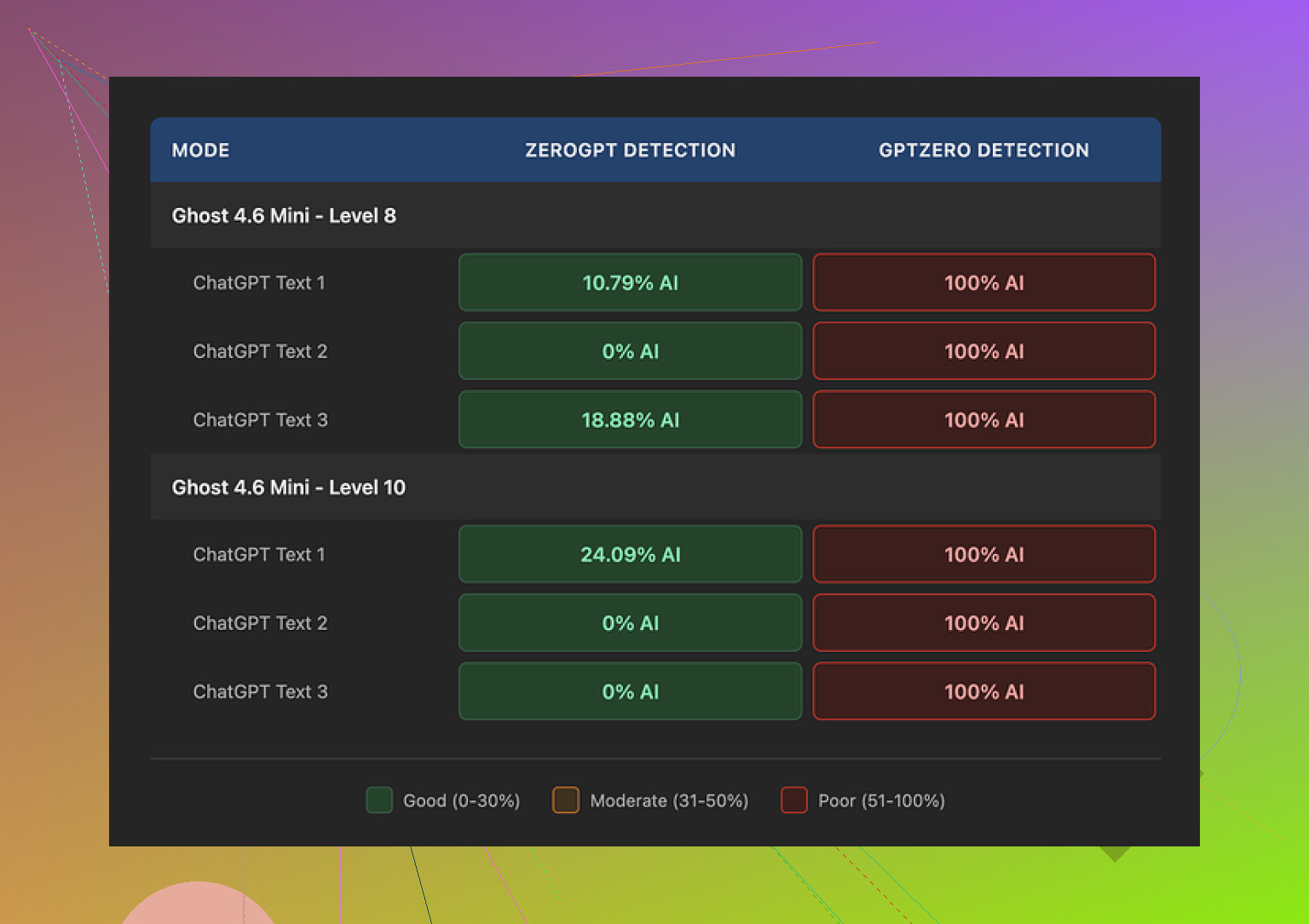
So if your main reason for using this is “beat GPTZero”, my experience was: it did not.
Writing quality at different intensity levels
This is where things got weird.
At intensity 8:
- I would put quality around 7 out of 10.
- Sentences mostly made sense.
- I noticed:
- some dropped words
- a few awkward joins
- phrasing that felt like an ESL writer rushing.
Example patterns I kept seeing:
- “Coastlines areas” instead of “coastal areas”
- Phrases missing a small but important word, like “feeling quite more frequent flooding” where a native speaker would say “feeling much more frequent flooding” or better, rewrite it entirely.
At intensity 10:
- Quality slid a bit, maybe around 6.5 out of 10.
- Output started to inject odd phrases that did not fit the tone.
One of the worst ones:
- In a climate science paragraph, out of nowhere it dropped “god knows” in the middle of a sentence.
- The rest of the paragraph was formal.
- That one phrase felt like someone pasted a random Reddit reply into a journal article.
Higher intensity also seemed to:
- increase grammatical errors
- break sentence rhythm
- push colloquial bits into places where they did not belong.
So, yes, the text looked less like raw AI, but also less like anything a careful human would submit.
Engines and presets
Ghost Mini vs Ghost Pro:
- Mini felt a bit safer, more conservative edits.
- Pro went heavier on rewrites, though you only get Pro on paid plans.
- I did not see a big difference in detector results between them, both got crushed by GPTZero.
Style presets (academic, casual, etc.):
- Minor surface changes.
- Did not rescue it on detectors.
- Sometimes made phrasing even stranger, especially at higher intensity.
Length and structure
One thing I actually liked:
- It keeps the original length close to intact.
Most other humanizers I tried inflate word count by 40 to 50 percent, like they are trying to drown the detectors in fluff. StealthWriter usually stayed near the same length and did not balloon paragraphs into essays.
For structured text, that helped:
- bullet lists stayed readable
- headings still made sense with their paragraphs
- sections did not become walls of text.
Free tier and pricing
What you get without paying:
- 10 “humanizations” per day
- up to 1,000 words per run
- you need an account
Ghost Pro sits behind the paywall, so on the free plan you mostly see Ghost Mini behavior.
Paid plans:
- around 20 to 50 dollars per month depending on how many words and features you want.
Given how it performed for me, the price felt heavy. I did not see enough reliability with detectors to justify a long subscription.
Compared to Clever AI Humanizer
Of the tools I tried, Clever AI Humanizer gave me:
- more natural text
- fewer random weird phrases
- outputs that felt closer to a human rewrite in flow and word choice
And it is fully free.
For the same test chunks:
- Clever’s outputs passed more casual spot checks
- Subjectively felt more “student who wrote this last night” and less “AI model trying to be quirky”.
So if your choice is between StealthWriter and something like Clever AI Humanizer, I would lean toward Clever unless you have a very specific reason to pay for presets and dual engines.
Final thoughts from using it daily for a week
After a week of messing with settings and feeding it different tones:
- It did not escape GPTZero even once for me.
- ZeroGPT could be tricked sometimes at higher intensity, but the text got messy at those levels.
- Quality was passable at mid intensity but not strong.
- Higher intensity increased weirdness more than it increased safety.
The only solid upside I saw:
- length preservation
- generous free daily limit, if you are only testing
For anything serious, I would treat it as a rough rewriter, not a “humanizer”. And even then, I would still edit line by line before sending the output anywhere important.
1 Like
I used StealthWriter for about 2 weeks for blog posts, email drafts, and one academic-style piece. Short version: it helps a bit as a rephraser, but it will not improve your writing on its own.
Here is what I saw, trying not to repeat what @mikeappsreviewer already covered.
Pros from my use:
-
Fast rephrasing
It turns a rough paragraph into something cleaner. Good when you stare at a sentence and hate it. -
Length control
It keeps paragraphs close to the same size. Helpful if you write for word-limited assignments or strict briefings. -
OK for low stakes content
For emails, internal docs, casual posts, it is fine at medium intensity. I used 5 to 7 most of the time.
Cons:
-
Style flattening
Your voice gets washed out. Everything starts to sound like a generic online article.
If you rely on humor, personal tone, or a niche voice, you will need to put that back in by hand. -
Weird phrasing
I agree with @mikeappsreviewer on the ESL vibe. I saw phrases like:- “highly much better choice”
- “people are feeling more stronger about”
These slip through if you do not read carefully.
-
Detector issues
I tested with GPTZero and ZeroGPT as well.- GPTZero flagged most outputs as AI, even at mid intensity.
- ZeroGPT was mixed. Some passed at higher levels, but quality dropped.
If your main goal is AI detection avoidance, this tool is unreliable.
-
No real skill improvement
If you paste junk in, you get tidier junk out. It does not teach you better structure or argument.
For learning, it is weaker than using a regular LLM as an editor with comments.
How I got the best use from it:
-
Use it on single paragraphs, not whole articles.
Then compare your version and its version, and merge the parts you like. -
Avoid high intensity for serious work.
I stayed around 5 or 6. Above that I saw more grammar noise and tone shifts. -
Keep your first draft strong.
Outline manually. Write your own intro and conclusion. Use StealthWriter on the middle sections only. -
Always do a human edit pass.
I read everything out loud once. That catches almost all awkward lines.
If your goal is more “human” output for detectors, I had better luck with Clever Ai Humanizer. The flow felt closer to something a rushed student would write and the phrasing was less odd. You can test it here:
make your AI text sound more human
If your goal is to improve your writing skills, I would:
- Use an AI editor that explains changes line by line.
- Ask it to point out weak verbs, vague phrases, and repeated words.
- Rewrite yourself, then run a light rephrase if you still feel stuck.
SEO-friendly version of your topic description:
“StealthWriter AI Review for Content Writers: Is It Improving Your Writing or Only Rephrasing Text?
I started using StealthWriter AI to help with blog posts, emails, and long-form content. I wanted to see if it improves clarity, tone, and structure for real, or if it only replaces words with synonyms and creates generic content. I am looking for honest user reviews, real pros and cons, and practical tips on the best settings, use cases, and alternatives for writers who want natural text that passes AI detectors and still keeps their personal style.”
I’m pretty much in the same camp as @mikeappsreviewer and @sternenwanderer, but I’ll push a slightly different angle: StealthWriter is fine as a mechanical helper, not a writing coach, and it’s weaker than they make it sound if you care about voice.
Is it improving your writing or just rephrasing?
If you:
- Paste in something already clear and decently structured
- Run it at mid intensity (4–7)
you mostly get:
- cleaner sentences in spots
- slightly varied wording
- but also:
- your personal tone gets flattened
- occasional awkward ESL-ish phrasing slips in
So it’s not “improving your writing” in the sense of teaching you better structure, argument, or style. It’s reorganizing what you already did and sometimes downgrading it a bit. If your draft is weak, you end up with tidy-sounding weak content.
A place where I actually disagree a bit with the others: I found Ghost Pro can be useful for breaking you out of phrasing ruts if you’re stuck, especially on marketing-ish copy. But you have to treat its output as raw material, not something to ship. I’d never trust it unedited on academic or expert content.
Where it worked ok for me:
- Quick email rewrites when I was brain-fried
- Cleaning up repetitive wording in long blog sections
- Keeping length stable when a client wanted “same length, slightly different wording”
Where it fell apart:
- Anything where tone really matters: humor, strong personal brand, story-based posts
- When trying to “beat AI detectors” consistently. It might occasionally slide past one tool, then get nuked by another. Very hit-or-miss.
For detection-focused stuff, I actually had more natural-looking results with Clever Ai Humanizer. The flow felt more like an actual rushed human and less like a thesaurus machine trying too hard. If that’s your main use case, it’s worth testing here:
make your AI content sound more natural
How I’d use StealthWriter so it actually helps your writing:
- Write your own full draft first. Don’t let it do the thinking.
- Run only problem paragraphs through it at mid intensity.
- Compare your version and its version and manually merge the best bits.
- Do a final human edit: read aloud, fix all the weird “more stronger / highly much better” stuff that sometimes sneaks in.
If your goal is to actually get better at writing, you’ll get more value from:
- a regular LLM editor that explains changes
- or just brutal self-editing with a checklist (verbs, clarity, repetition)
StealthWriter is more like a fancy rephrase button. Handy sometimes. Not magic, not a real teacher, and definitely not something you can rely on alone for “human” writing that also keeps your unique voice intact.
Search-friendly version of what you’re asking about:
StealthWriter AI Review for Writers: Can It Really Boost Your Content Quality?
I’ve been testing StealthWriter AI to help with blog posts, email copy, and longer articles. My main questions were simple:
Does StealthWriter actually improve clarity, tone, and structure, or does it just swap words for synonyms and make everything sound generic?
From real-world use, it can help tidy up rough paragraphs and keep length under control, but it often flattens your writing style and sometimes introduces awkward phrasing. It is not a replacement for real editing or learning how to write better.
If you want more human-sounding text that can reduce AI detection issues and still feel natural, tools like Clever Ai Humanizer are worth trying alongside your own editing, so you keep control over your personal voice and overall quality.
If you strip away the marketing, StealthWriter sits in a weird middle ground: not useless, but also not the “secret weapon” for better writing that the landing page implies.
I’m broadly in the same camp as @sternenwanderer, @himmelsjager and @mikeappsreviewer, but I’d frame it like this:
What StealthWriter is actually good for
1. Mechanical reshaping, not real improvement
It’s decent at:
- Nudging sentence structure
- Keeping length roughly stable
- Giving you “another version” of a paragraph when your brain is empty
That can be genuinely useful if:
- You already know what you want to say
- Your draft is structurally sound
- You are okay sacrificing some voice in exchange for speed
I actually like it for:
- Client work where they only care about “sounds professional, same length”
- Quick variant generation for A/B testing short bits of copy
- Cleaning up small sections of long documents without touching everything
Where I slightly disagree with the others: I found Ghost Pro marginally better for marketing or product blurbs than they suggest. It sometimes surfaces phrasing I would not have thought of, which I then refine manually. So as a “phrase mining” tool, it has some value.
2. Length discipline
Compared to many humanizers that bloat content, StealthWriter respecting approximate length is underrated. If you write inside strict character or word constraints (social ads, meta descriptions, short abstracts), that matters a lot.
Where it works poorly
1. Style and voice
Everyone already hinted at this, but it’s worth underlining: if your personal style is part of your “product,” StealthWriter is risky.
Typical issues I kept seeing:
- Jokes and rhythm get flattened
- Rhetorical questions or punchy lines turn into neutral statements
- Repeated subtle “ESL-ish” constructions creep in, which is much harder to spot in your own work than in examples
It’s not just that it sounds generic. It pulls your tone toward a weird midpoint that feels neither fully human nor fully AI, which is exactly the zone that makes sensitive readers uncomfortable.
2. AI detection paranoia
If your primary goal is “beat detectors,” StealthWriter is too unpredictable:
- Some runs look okay to one detector
- Another detector calls the same text obviously AI
- Higher intensities that sometimes fare better with detectors also degrade grammar and coherence
And frankly, the whole “write to beat detectors” game is a treadmill. Detectors update, patterns change, you are always one step behind.
Where Clever Ai Humanizer fits in
Given what you are asking (natural text, keeps more of your voice, less generic), Clever Ai Humanizer is worth putting into the mix, but not as a magic bullet.
Pros of Clever Ai Humanizer:
- The flow often reads closer to an actual rushed human, particularly for casual or student-level writing
- Less of the “robot politely rephrased this blog post” feel
- In my experience, fewer bizarre tone jumps like “god knows” inside formal paragraphs
- Zero cost barrier to experiment, which makes it safer to test alongside your own editing workflow
Cons of Clever Ai Humanizer:
- Still not your voice by default; you must tweak phrasing if you care about brand or personality
- On more technical or academic passages, it can oversimplify nuance unless you carefully review
- It can occasionally drift slightly off-topic if the source text is already vague
- Same fundamental limitation as StealthWriter: it cannot teach you how to construct arguments, it only reshapes what is already there
Compared to StealthWriter, I’d lean on Clever Ai Humanizer when:
- You want something that feels like a human who writes “good enough,” not like a polished corporate ghostwriter
- You are experimenting with different tones and want to see which one feels most natural to you as a base to edit from
StealthWriter, on the other hand, is more:
- “Corporate rephrase tool with presets”
- Slightly better when you need to hold length and structure almost exactly
How to decide which to use when
Instead of asking “Which tool makes my writing better?” I’d flip it to “Which job am I actually trying to do right now?”
Use StealthWriter when:
- The structure and logic are fixed and must stay almost identical
- You only want a fresher surface without changing length
- You plan to do a careful pass afterward to fix tone and small grammar glitches
Use Clever Ai Humanizer when:
- You want something that feels more like a human draft to start from
- Tone can be a bit looser and more conversational
- You are tired of the “generic blog” feel and want something closer to informal or student-level writing
And honestly, for actual skill improvement, both are secondary tools. You get more growth from:
- Letting a general LLM mark weak verbs, vague sentences and structural issues, then rewriting yourself
- Keeping a small checklist for every draft (clarity, specificity, variety, rhythm) and editing line by line
So, if you feel like StealthWriter is “just rephrasing in a generic way,” your instinct is basically correct. Treat it as a convenience tool for certain narrow tasks, not as a writing upgrade. Pair it or Clever Ai Humanizer with deliberate self-editing if improving your own style is the real goal.