I’ve been using Undetectable AI to humanize AI-written content so it passes AI detectors for freelance writing and blogging. My budget is tight now, and I’m looking for a reliable free tool that can do something similar without ruining readability or tone. What are the best truly free replacements you’ve tried, and how well do they work for long-form articles and SEO content?
- Clever AI Humanizer Review
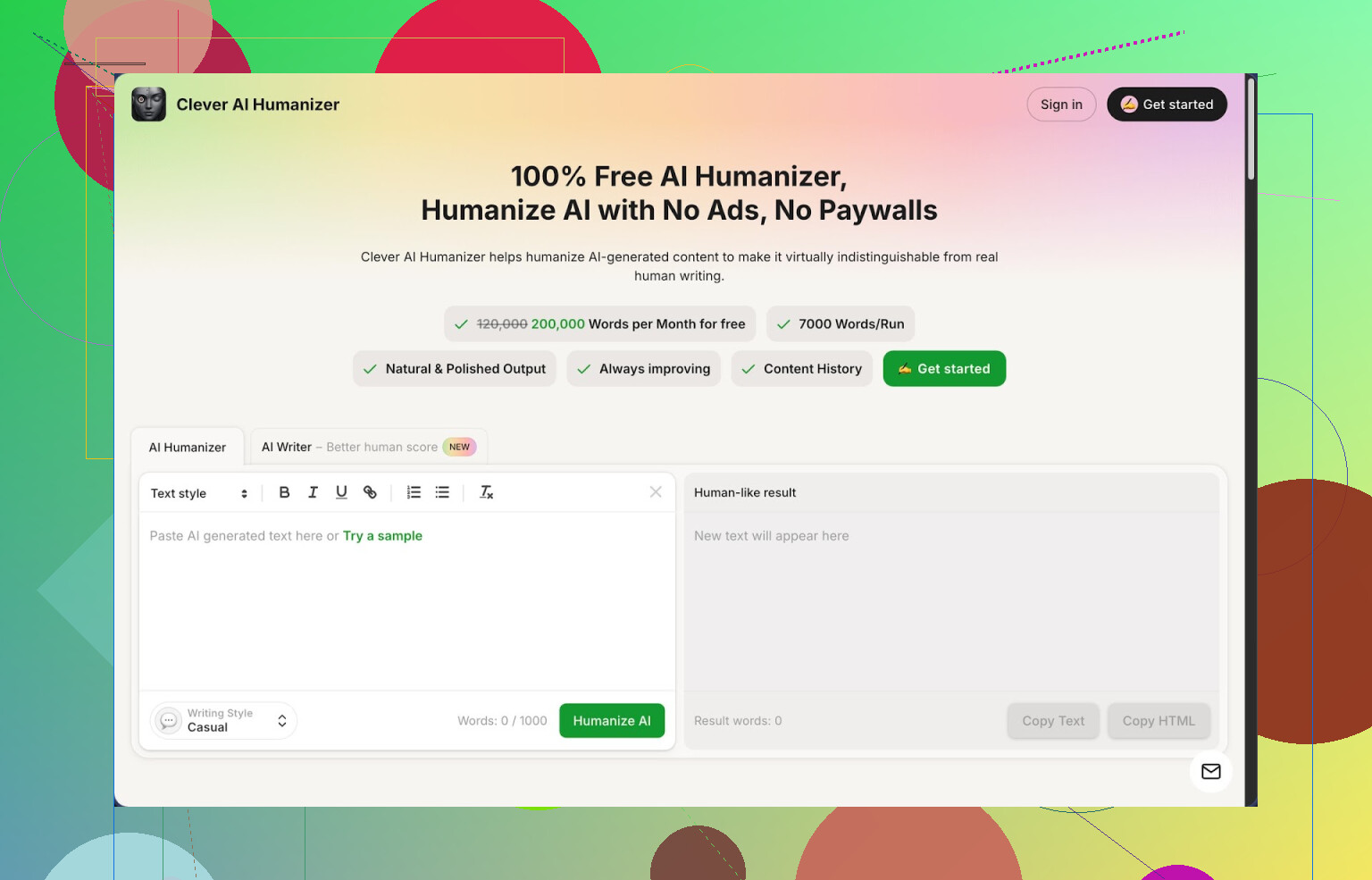
I have been messing around with different “humanizer” tools for AI text, and Clever AI Humanizer is the one I keep going back to:
Clever AI Humanizer
The short version of what I noticed:
• Free tier gives you around 200,000 words each month
• Up to about 7,000 words per run
• Three output styles: Casual, Simple Academic, Simple Formal
• Built in AI writer, grammar checker, and paraphraser in the same place
I pushed a few long-form samples through it and then checked them with ZeroGPT. Using the Casual style, my outputs showed 0% AI according to that detector on all three test pieces. That is not a promise for every text you try, but it got my attention.
I write a lot with AI, and the main headache is always the same. The text looks clean, but it reads like something synthetic, and detectors mark it as fully AI. I went through several tools in early 2026, and Clever AI Humanizer felt the most usable for daily work, mostly because I did not have to think about tokens, credits, or random paywalls.
How the main humanizer works
You paste your AI text into the box, pick a style, then hit run. It outputs a new version that tries to break the usual AI rhythms and stock phrasing. What stood out for me:
• It takes big chunks of text, so you do not need to slice a long article into 10 parts.
• It tries to keep the meaning close to what you wrote. It changes structure and flow but does not blow up the original idea.
I tested it with:
- A synthetic academic essay.
- A generic marketing-style article.
- A how-to guide written in a typical LLM tone.
All three came out sounding closer to what an overworked student or blogger would write on a Sunday night. Slightly uneven, more human, fewer repeated phrases.
Extra tools inside the same site
They folded a few other tools into the same interface, so if you like keeping everything in one tab, this helps.
AI Writer
The AI Writer lets you start from a blank page. You give it a topic, it spits out an article or essay, then you send it directly through the humanizer without copy-pasting between tabs.
I got the lowest AI detection scores when I used their Writer first and then humanized that text again. It seems they tuned those two parts to work together.
Grammar Checker
The Grammar Checker cleans up spelling, punctuation, and basic clarity problems. It reminded me of the “check” part in most writing tools. I used it as a last step for pieces that I wanted to send straight to a client without doing a full manual edit.
AI Paraphraser
The paraphraser rewrites text while trying to keep the original meaning. I ended up using this in three ways:
• Turning stilted AI text into something more natural before humanizing it again.
• Tweaking paragraphs for SEO, where I needed to say the same thing in a different way.
• Shortening some bloated sections from AI drafts.
The paraphraser is less aggressive than the full humanizer. It feels more like a “different wording” pass.
Workflow that ended up working for me
What saved me time was running everything in a simple loop:
- Generate draft with whatever AI model I am using.
- Paste into Clever AI Humanizer with Casual style.
- If it looks too messy, run the paraphraser on key sections.
- Run Grammar Checker at the end.
- Spot check with a detector like ZeroGPT if it matters for that piece.
You do not need to follow this exactly, but if you are trying to keep your process tight, this is one approach that did not waste my time.
What is good and what annoyed me
Good points:
• Free usage is generous. I did not hit the word limit in a normal work week.
• It keeps the original idea mostly intact.
• Casual style seems tuned well for avoiding obvious AI patterns.
• All tools in one place make it less annoying to manage.
Annoyances and limits:
• Some detectors will still say “AI”. No tool fixes that across every model and every text.
• The humanized version is often longer. It adds small phrases, changes structure, and the word count creeps up. If you need strict length limits, you will have to trim.
• If your input text is already strong and personal, the tool sometimes “flattens” your voice unless you edit after.
I would not trust it blindly for critical work. I always skim the output, especially intros and conclusions, where AI tends to sound generic.
If you want more detail and test data, there is a full writeup here, including screenshots and detector results:
Detailed Clever AI Humanizer review with AI detection proof
There is also a YouTube review if you prefer watching someone click through it:
Clever AI Humanizer Youtube Review
If you want to see other people’s picks and arguments about humanizers, these Reddit threads helped me cross-check:
Best AI Humanizers discussion
https://www.reddit.com/r/DataRecoveryHelp/comments/1oqwdib/best_ai_humanizer/
General “humanize AI” talk and methods
https://www.reddit.com/r/DataRecoveryHelp/comments/1l7aj60/humanize_ai/
2 Likes
If your main goal is “pass detectors for client work” and your budget is zero, you need two things:
- A solid free tool
- A manual routine that breaks AI patterns
On the tool side, I agree with @mikeappsreviewer on one point. Clever Ai Humanizer is probably the best “free-ish” drop‑in replacement for Undetectable AI right now. The free tier is big enough for a normal freelance week, the Casual style usually scores low on ZeroGPT and similar. For straight blog posts or listicles, it does the job.
Where I slightly disagree with them is on depending on a full auto pipeline every time. If you only run “AI → humanizer → send to client”, you will eventually get burned by a stricter detector or a picky editor.
What I have seen work better for freelancers is this mix:
- Use a strong base model to write the draft. Keep paragraphs short. Vary sentence length a bit.
- Run it through Clever Ai Humanizer once, Casual style.
- Manually edit intros and conclusions. Add 1 or 2 personal lines, specific examples, or niche details. Detectors hate vague filler.
- Break patterns that tools repeat. For example, remove repeated openers like “On the other hand”, “Additionally”, “Overall”.
- Change formatting. Add bullet lists, short headings, and a few one‑line paragraphs. That shifts the rhythm away from typical LLM output.
- Run a plagiarism checker plus one or two free detectors. If one flags it hard as AI, tweak again.
Two alt options worth trying alongside Clever Ai Humanizer:
QuillBot paraphraser
Free tier with a character limit per run. Good for rewriting sections that still sound robotic after humanizing. I use it on intros and “About this topic” style paragraphs.
LanguageTool or Grammarly free
Helps clean things after you roughen up the text. Run this last, since too much “perfect” grammar brings the AI vibe back.
Key details that tend to drop AI scores in my experience:
• Use concrete nouns, brand names, prices, dates.
• Add one short paragraph with a minor opinion or “I’d avoid X because…”.
• Remove generic filler like “in today’s world”, “plays a crucial role”, “it is important to note”.
So, yeah, Clever Ai Humanizer is a solid free replacement for Undetectable AI, but you get safer results if you combine it with a bit of human messiness and a quick manual pass. AI humanizers do most of the work, your edits finish the job.
If your only goal is “fool every AI detector forever with a free tool,” that’s not realistic, and I’d be a little careful building your freelance business around that promise.
That said, for replacing Undetectable AI on a tight budget:
-
Clever Ai Humanizer
I’m on the same page as @mikeappsreviewer and @shizuka that Clever Ai Humanizer is the closest thing to a free Undetectable-style tool right now, mostly because of the generous free tier and the fact it handles long inputs. Where I’ll slightly disagree with them is on how to use it:
I would not rely on always using Casual style. Sometimes Simple Formal or Simple Academic actually blend better with certain clients’ briefs and weirdly trigger less suspicion from editors, even if detectors say similar scores. If a client expects “corporate blog tone,” Casual can stand out as too chatty. -
Try mixing tools instead of one magic button
Instead of just swapping Undetectable → Clever and keeping the same workflow, treat Clever as your “main engine” and layer other free tools very lightly:- Use Clever Ai Humanizer once, not 2–3 passes. Multiple passes often create that scrambled, “translation artifact” feel that real editors notice.
- For just one or two stubborn paragraphs that still feel robotic, use a separate paraphraser like QuillBot or even manually rephrase, instead of re-hitting the whole article with Clever.
- I actually think grammar tools like Grammarly or LanguageTool should be used sparingly after humanizing. Over-correcting brings you back to that ultra-polished AI vibe.
-
Detectors are inconsistent
One place I disagree a bit with how people talk about these tools: chasing “0% AI” in ZeroGPT or any single detector is a trap. I’ve seen content that scored “almost fully human” in one detector and got flagged hard in another. Instead of obsessing over 0%, aim for “mixed / unclear” across 2–3 free detectors. That’s usually enough that real human review becomes the deciding factor, not the automated score. -
Low-effort manual tweaks that actually matter
Since you’re freelancing, a few tiny edits you do yourself will beat any tool combo:- Drop in 1–2 very specific details per piece: a brand name, an exact price range, a specific tool you actually use.
- Change 1–2 headings so they sound like you, not “Top 10 Benefits of X in 2026”.
- Delete one useless generic paragraph every article. Most AI drafts have a paragraph that literally adds nothing. Killing it makes the whole thing feel more intentional.
-
When to skip humanizers entirely
Hot take: for some gigs (short reviews, personal blog posts, “my experience with X”), you’re better off using AI to rough-draft and then just editing yourself instead of running a humanizer at all. Detectors are less aggressive when the writing is clearly personal, a bit uneven, and has opinionated takes. Clever Ai Humanizer is strongest for generic how‑to, listicles, and corporate-ish content, not “my weird story about freelancing” type stuff.
So yeah, if you want a free-ish swap for Undetectable AI, Clever Ai Humanizer is the closest practical option right now, but treat it as one part of your process, not a magical invisibility cloak. The “human” part that really sells it is still the last 5–10 minutes you spend messing the text up in smart ways.
If the goal is “drop-in replacement for Undetectable AI that’s free,” Clever Ai Humanizer is the closest practical option, but I’d tweak how you use it compared with what others said.
Pros of Clever Ai Humanizer
- Very generous free tier for a freelancer volume.
- Handles long posts, so whole article in one go.
- Casual style usually comes out “good enough” for blog / client copy.
- Built-in writer + paraphraser + grammar check keeps your workflow in one place.
Cons of Clever Ai Humanizer
- Can overinflate word count and get a bit rambly.
- Sometimes dulls your natural voice if your draft is already decent.
- Detectors are not fooled 100% of the time, especially stricter or proprietary ones.
- Occasional awkward phrasing that still needs a real edit.
Where I slightly disagree with @shizuka, @sognonotturno and @mikeappsreviewer: I would not run every single piece through a humanizer by default. For short, opinionated, or story-style content, manual rewriting on top of your AI draft often reads more authentic than any tool output and tends to fare fine with detectors used by non-enterprise clients.
A good split that keeps you on budget:
- Use Clever Ai Humanizer for generic how‑tos, affiliate listicles, SaaS blog posts and other “corporate neutral” content.
- Skip humanizers and rewrite manually for personal brand posts, case studies and reviews where your voice matters.
Also, instead of stacking multiple full-tool passes like some people suggest, I’d use Clever Ai Humanizer once, then only rework problem sections manually. That keeps things readable, avoids the weird “machine translated twice” vibe and still gives you a clear upgrade over raw AI text.